
Anúncios
Staying informed about weather conditions has never been more critical, especially when severe storms threaten our daily routines and safety.

Modern weather forecasting applications have revolutionized how we prepare for atmospheric changes, providing real-time updates and detailed storm tracking capabilities directly to our smartphones. These powerful tools combine sophisticated meteorological data with user-friendly interfaces, making complex weather patterns accessible to everyone.
Anúncios
Whether you’re planning outdoor activities, managing agricultural operations, or simply wanting to stay safe during severe weather events, having a reliable weather app on your device can make all the difference. Let’s explore everything you need to know about weather and storm prediction applications.
🌪️ Why Weather Apps Are Essential in Today’s World
Climate patterns have become increasingly unpredictable, with extreme weather events occurring more frequently across the globe. Traditional weather forecasts on television or radio simply can’t provide the immediacy and specificity that modern weather apps deliver.
Anúncios
These applications utilize data from thousands of weather stations, satellites, and radar systems worldwide. The information is processed through advanced algorithms that can predict weather patterns with remarkable accuracy, often down to your exact location.
For individuals living in storm-prone areas, these apps aren’t just convenient—they’re potentially life-saving. Receiving timely alerts about approaching tornadoes, hurricanes, or severe thunderstorms provides crucial minutes or hours to seek shelter and protect property.
⚡ Key Features to Look for in Storm Tracking Apps
Not all weather applications are created equal. When selecting an app specifically for storm and severe weather monitoring, certain features stand out as particularly valuable.
Real-Time Radar Visualization
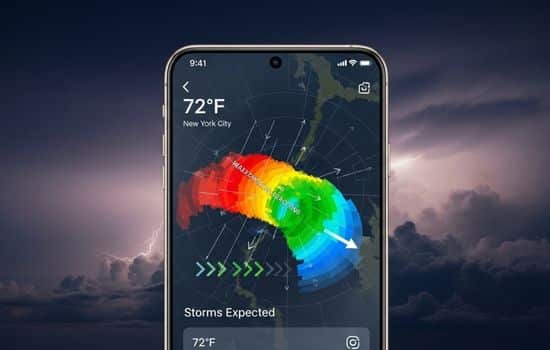
The most effective weather apps provide interactive radar maps that update continuously. These visual representations show precipitation intensity, storm movement direction, and velocity. High-quality apps offer multiple radar layers, including base reflectivity, composite reflectivity, and velocity data.
Users can zoom in to street-level detail or zoom out to see regional weather patterns. Animation features allow you to see how storms have developed over the past hours and project their future paths.
Severe Weather Alerts and Notifications
Push notifications for severe weather warnings are perhaps the most critical feature. The best apps connect directly to national meteorological services and send immediate alerts when watches or warnings are issued for your area.
Customizable notification settings let you choose which types of alerts you receive—from severe thunderstorm warnings to flash flood alerts, tornado warnings, and hurricane updates.
Lightning Detection Capabilities
Advanced weather apps include lightning detection networks that show strike locations in real-time. This feature is invaluable for outdoor enthusiasts, event planners, and anyone working in exposed environments. Knowing when lightning is within a dangerous radius allows for proactive safety measures.
Hurricane and Tropical Storm Tracking
During hurricane season, specialized tracking features become essential. Quality apps display forecast cones, wind speed projections, and potential impact zones. Historical storm paths help users understand typical patterns for their region.


🌦️ Understanding Weather Data Sources
The accuracy of any weather app depends entirely on its data sources. Most reputable applications pull information from multiple authoritative sources to provide comprehensive forecasts.
Government meteorological agencies like NOAA (National Oceanic and Atmospheric Administration) in the United States, ECMWF (European Centre for Medium-Range Weather Forecasts) in Europe, and similar organizations worldwide provide the foundation for most weather data.
Satellite imagery from geostationary and polar-orbiting satellites offers broad atmospheric views, tracking cloud formation, storm development, and temperature variations across vast regions.
Ground-based radar stations form networks that detect precipitation, measure its intensity, and calculate storm movement. Doppler radar technology can even identify rotation within storms—a key indicator of potential tornado formation.
Some premium apps also incorporate data from personal weather stations, creating hyper-local forecast models that account for microclimates in specific neighborhoods or properties.
📱 How Weather Apps Predict Storms with Accuracy
Storm prediction combines observational data with computational meteorology. Weather apps access numerical weather prediction models that simulate atmospheric conditions using complex mathematical equations.
These models divide the atmosphere into three-dimensional grids, calculating temperature, pressure, humidity, and wind at each point. By running these calculations forward in time, meteorologists can project how weather systems will evolve.
Machine learning algorithms have recently enhanced prediction accuracy. These systems analyze historical weather patterns and current conditions to identify similar scenarios and refine forecast models accordingly.
Ensemble forecasting runs multiple prediction models with slightly varied initial conditions. By comparing results, meteorologists can assess forecast confidence and identify the most likely scenarios.
🛡️ Safety Features That Save Lives
Beyond forecasts and radar, the best weather apps include dedicated safety features designed to protect users during dangerous weather events.
Emergency Contact Integration
Some applications allow users to share their location and safety status with designated emergency contacts during severe weather. This feature provides peace of mind for families and enables quick response if someone becomes unreachable.
Shelter Location Services
When severe weather strikes while you’re away from home, knowing the nearest safe shelter can be critical. Advanced apps include databases of public shelters, storm-resistant buildings, and emergency facilities.
Weather Radio Integration
NOAA Weather Radio provides continuous broadcasts of weather information directly from National Weather Service offices. Some apps stream these broadcasts, ensuring access to official information even when internet connectivity is limited.
Offline Functionality
Power outages and cellular network disruptions often accompany severe storms. The most reliable weather apps cache recent data and radar images, allowing limited functionality even without active internet connections.
🌍 Global Coverage vs. Regional Specialization
When choosing a weather app, consider whether you need global coverage or prefer an application optimized for your specific region.
Global apps like Windy provide worldwide weather data with consistent interfaces and features regardless of location. These are ideal for travelers, international businesses, and anyone monitoring weather across multiple regions.
Regional apps often provide superior accuracy for specific countries or states because they tap into localized data sources and regional forecast models. They may also include area-specific features like pollen counts, air quality indices, or localized severe weather terminology.
💡 Practical Applications Beyond Daily Forecasts
Weather and storm apps serve purposes far beyond deciding whether to carry an umbrella. Various professions and activities benefit tremendously from detailed meteorological information.
Agriculture and Farming
Farmers rely on accurate precipitation forecasts, temperature predictions, and storm warnings to make critical decisions about planting, harvesting, and protecting crops. Frost warnings, hail forecasts, and drought monitoring features are particularly valuable.
Aviation and Marine Navigation
Pilots and sailors need precise wind forecasts, visibility predictions, and storm tracking to ensure safe travel. Specialized weather apps provide aviation-specific data like turbulence forecasts, icing conditions, and airport weather observations.
Event Planning and Outdoor Activities
Wedding planners, festival organizers, and outdoor event coordinators use weather apps to make informed decisions weeks or months in advance. Hour-by-hour forecasts help schedule activities around expected weather conditions.
Construction and Industrial Operations
Construction projects depend on favorable weather conditions. Lightning alerts protect workers, while precipitation forecasts help schedule concrete pours and other weather-sensitive tasks. Wind forecasts are critical for crane operations and high-rise work.
Emergency Management
First responders and emergency management agencies use professional-grade weather apps to coordinate responses to disasters, allocate resources, and communicate with affected populations during severe weather events.
🔧 Customization Options That Enhance User Experience
The best weather apps recognize that different users have different needs. Extensive customization options allow each person to tailor the experience to their preferences.
Widget configurations let you see critical information directly on your home screen without opening the app. Customizable data fields mean you can prioritize the metrics most relevant to your activities—whether that’s UV index, wind speed, visibility, or barometric pressure.
Theme options ranging from dark mode for nighttime viewing to high-contrast displays for outdoor visibility ensure comfortable use in any situation. Map layer selections allow you to overlay temperature data, wind patterns, cloud cover, or precipitation intensity on your radar views.
Location management features let you save multiple locations and quickly switch between them. This is particularly useful for people who travel frequently or have family members in different areas they want to monitor.
📊 Comparing Free Versions with Premium Subscriptions
Most weather apps offer free versions with basic functionality, while premium subscriptions unlock advanced features. Understanding what you gain with paid upgrades helps determine whether the investment is worthwhile.
Free versions typically include standard forecasts, basic radar imagery, and government-issued weather alerts. Advertisements support these free services, which can sometimes interrupt the user experience during critical weather situations.
Premium subscriptions generally remove advertisements and add features like extended forecast periods (15-day instead of 7-day), higher-resolution radar imagery, minute-by-minute precipitation predictions, and customizable alert parameters.
Advanced data layers—such as satellite imagery, lightning strike locations, storm tracks, and specialized forecast models—often require premium access. Professional-grade features like radar archive access and detailed meteorological charts typically sit behind premium paywalls.
For casual users checking daily forecasts, free versions often suffice. However, anyone in storm-prone regions, outdoor professionals, or weather enthusiasts will find premium features invaluable for safety and planning purposes.
🎯 Windy: A Comprehensive Solution for Weather Tracking
Among the numerous weather applications available today, Windy stands out as a particularly powerful and versatile option for both casual users and meteorology enthusiasts.
The application presents complex meteorological data through an intuitive, visually stunning interface. Animated wind patterns flow across the screen, providing immediate understanding of atmospheric circulation patterns without requiring specialized knowledge.
Windy aggregates data from multiple respected forecast models including GFS, ECMWF, and ICON, allowing users to compare predictions and assess forecast confidence. This multi-model approach provides more reliable long-range forecasts than single-source applications.
The app’s layer system lets users visualize dozens of atmospheric parameters—from basic temperature and precipitation to advanced metrics like cape (convective available potential energy), wind gusts at various altitudes, and wave heights for marine applications.
Storm tracking capabilities include hurricane paths, severe weather warnings, and lightning detection. The community features allow users to share observations and photographs, creating a network of ground-truth reports that complement official forecasts.
Whether accessed through smartphone apps or web browsers, Windy provides consistent functionality across platforms. The free version offers remarkable depth, while the premium subscription adds forecasts for specific GPS coordinates, enhanced notifications, and detailed weather comparison tools.
🌟 Making the Most of Your Weather App
Downloading a weather app is just the first step. Maximizing its value requires understanding how to interpret data and integrate forecasts into your decision-making processes.
Spend time exploring all available features rather than relying solely on the basic forecast screen. Discover radar animation controls, alternative forecast models, and historical data comparison tools that provide context for current conditions.
Configure notifications carefully to balance staying informed with avoiding alert fatigue. Set thresholds appropriate for your location and activities—severe thunderstorm warnings matter more in areas prone to such events than in regions where they’re rare.
Learn basic meteorological concepts to better understand what the data means. Recognizing the significance of dropping barometric pressure, understanding dew point in relation to comfort and storm development, and interpreting radar reflectivity values enhances your ability to anticipate weather changes.
Compare multiple forecast models when planning important activities. If several models agree on weather conditions, confidence in the forecast increases. When models diverge significantly, recognize increased uncertainty and plan accordingly.
Regularly update your app to access the latest features, bug fixes, and data source improvements. Enable location services for accurate local forecasts, but review privacy settings to ensure your comfort level with data sharing.
🔮 The Future of Weather Prediction Technology
Weather forecasting technology continues advancing rapidly, with innovations promising even more accurate and detailed predictions in coming years.
Artificial intelligence and machine learning systems are becoming increasingly sophisticated at pattern recognition in atmospheric data. These technologies can identify subtle signals that human forecasters and traditional models might miss, improving accuracy especially for localized severe weather events.
Quantum computing may revolutionize numerical weather prediction by processing the enormous calculations required for high-resolution global models in fractions of current timeframes. This could extend accurate forecast periods and improve prediction of rapidly-developing storms.
Expanded satellite networks with improved sensor technology will provide more detailed atmospheric observations. Small satellite constellations could offer updates every few minutes rather than every hour, tracking storm development in near-real-time.
Integration with smart home systems will allow weather apps to automatically adjust thermostats, close smart blinds before storms, or alert you if you’ve left windows open when rain approaches. Connected vehicle systems could reroute navigation based on approaching severe weather.
Augmented reality features may soon overlay weather information directly onto your view of the sky through smartphone cameras or AR glasses, helping you visualize approaching storm systems and understand their characteristics at a glance.
🌈 Staying Safe and Informed in Any Weather
Weather apps have transformed from simple forecast tools into comprehensive safety systems that protect lives and property. The technology puts professional-grade meteorological data into everyone’s hands, democratizing access to information that was once available only to specialists.
Choosing the right application for your needs, learning to interpret its data, and integrating forecasts into your planning processes creates a powerful system for weather awareness. Whether monitoring daily conditions or tracking potentially dangerous storms, modern weather apps provide the information necessary to make informed decisions.
The investment of time to understand your chosen app’s features pays dividends in safety, convenience, and peace of mind. In our increasingly unpredictable climate, having reliable weather information isn’t just helpful—it’s essential for navigating daily life and protecting what matters most.
Download a quality weather and storm tracking app today, explore its capabilities, and experience the confidence that comes from staying one step ahead of changing weather conditions. Your safety and those you care about may one day depend on the alerts and information these remarkable tools provide.
