
Anúncios
Imagine performing at your absolute best—effortlessly focused, fully immersed, and achieving results that seem almost impossible. This is the flow state experience.
The journey to skill mastery isn’t just about practice hours or raw talent. It’s about tapping into a psychological state where your abilities align perfectly with the challenge at hand, creating an environment where learning accelerates and performance peaks naturally. This optimal state of consciousness, known as flow, has been studied extensively by psychologists and adopted by elite performers across every field imaginable.
Anúncios
Whether you’re an athlete training for competition, a musician perfecting your craft, a programmer solving complex problems, or a creative professional pushing boundaries, understanding and harnessing flow state can dramatically accelerate your path to mastery. The science behind this phenomenon reveals that flow isn’t mystical—it’s a trainable skill accessible to anyone willing to create the right conditions.
🧠 What Exactly Is Flow State?
Flow state, a term coined by psychologist Mihaly Csikszentmihalyi in the 1970s, describes a mental state where a person becomes fully immersed in an activity with energized focus, complete involvement, and enjoyment in the process itself. During flow, you lose your sense of time, self-consciousness fades away, and your actions and awareness merge into a seamless experience.
Anúncios
This isn’t just feeling good while working—it’s a measurable neurological state. Brain imaging studies show that during flow, the prefrontal cortex temporarily deactivates in a process called transient hypofrontality. This shutdown of your brain’s critic and self-monitoring systems allows for intuitive decision-making and creativity to flourish without second-guessing.
The neurochemical cocktail that accompanies flow includes dopamine, norepinephrine, endorphins, anandamide, and serotonin—all pleasure and performance-enhancing chemicals that make the experience intrinsically rewarding. This explains why flow feels so good and why people become addicted to activities that consistently produce this state.
The Golden Balance: Challenge Meets Skill
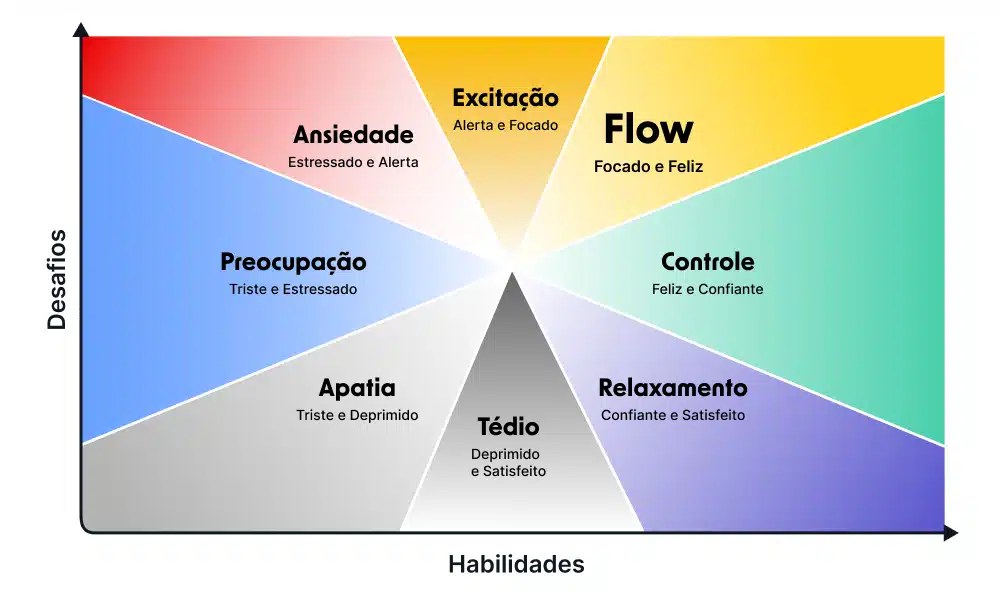
The key to entering flow lies in finding the perfect balance between the challenge you’re facing and your current skill level. If a task is too easy relative to your abilities, boredom sets in. If it’s too difficult, anxiety and frustration take over. Flow exists in that narrow channel where you’re stretched just beyond your comfort zone—typically about 4% beyond your current abilities.
This sweet spot forces your brain to operate at peak capacity without overwhelming it. You’re engaged enough to maintain focus but not so stressed that performance degrades. Understanding this principle transforms how you structure your practice sessions and approach skill development.
Elite performers instinctively adjust their training to maintain this balance. They constantly seek challenges slightly above their current level, ensuring they remain in the growth zone where flow is most accessible. This deliberate calibration separates those who plateau from those who continue advancing toward mastery.
🎯 The Nine Characteristics of Flow Experience
Csikszentmihalyi identified nine distinct elements that characterize the flow experience. Recognizing these features helps you identify when you’re in flow and understand what conditions to recreate:
- Clear goals: You know exactly what you’re trying to accomplish at every moment
- Immediate feedback: You receive instant information about your performance and progress
- Challenge-skill balance: The task difficulty perfectly matches your abilities
- Merging of action and awareness: Your movements become automatic and intuitive
- Elimination of distractions: Irrelevant stimuli fade from consciousness
- No fear of failure: Self-consciousness and worry about outcomes disappear
- Loss of self-consciousness: You stop thinking about yourself as separate from the activity
- Time distortion: Hours feel like minutes or seconds stretch into extended experiences
- Autotelic experience: The activity becomes intrinsically rewarding regardless of external outcomes
Not every flow experience includes all nine elements, but the more present, the deeper and more productive the flow state becomes. Structuring your practice environment to maximize these characteristics dramatically increases the frequency and depth of your flow experiences.
Why Flow Accelerates Skill Acquisition
Flow doesn’t just feel good—it fundamentally changes how your brain processes information and consolidates learning. During flow, your brain releases neurochemicals that enhance pattern recognition, information processing, and memory formation. The dopamine surge, in particular, helps encode the neural pathways being activated, making learned skills more permanent.
Research shows that learning in flow can be up to 500% more effective than conventional learning states. This acceleration happens because flow eliminates the cognitive interference that normally slows skill acquisition. Without self-doubt, distraction, or excessive conscious processing, your brain can dedicate all resources to the task at hand.
The state also facilitates what neuroscientists call “chunking”—the process of combining individual skills into larger, more efficient units. As you repeat movements or thought patterns in flow, your brain creates shortcuts that allow complex sequences to be executed automatically, freeing up mental resources for higher-level strategic thinking.
🚀 Creating the Conditions for Flow
While flow can happen spontaneously, masters understand how to engineer the conditions that make it more likely. The environment, both internal and external, plays a crucial role in flow accessibility.
Environmental Design for Optimal Performance
Your physical environment significantly impacts your ability to enter flow. Minimizing distractions is paramount—this means silencing notifications, creating visual order in your workspace, and establishing boundaries that protect your focused time. Many peak performers create dedicated spaces associated exclusively with their craft, training their brain to enter flow mode upon entering that environment.
Lighting, temperature, and even music can influence flow states. Research suggests that moderate ambient noise (around 70 decibels) or certain types of music without lyrics can enhance flow for creative work, while complete silence may be preferable for analytical tasks. Experiment to discover your optimal conditions.
The Pre-Flow Ritual
Elite athletes, performers, and professionals often develop pre-performance rituals that signal their brain it’s time to enter flow. These rituals might include physical warm-ups, breathing exercises, reviewing goals, or listening to specific music. The consistency of these rituals creates a psychological trigger that makes the flow state more accessible over time.
Your ritual doesn’t need to be elaborate. Even five minutes of intentional preparation—setting clear objectives, eliminating distractions, and mentally committing to full engagement—can significantly increase your chances of entering flow during the subsequent work session.
The Practice Architecture That Builds Mastery
Not all practice is created equal when it comes to reaching mastery through flow. The structure of your practice sessions determines whether you’ll consistently access flow or struggle with frustration and plateaus.
Deliberate Practice Meets Flow State
Anders Ericsson’s research on deliberate practice emphasizes focused, goal-oriented training with immediate feedback—conditions that align perfectly with flow triggers. The most effective practitioners combine deliberate practice principles with flow state awareness, creating sessions that are both structured and immersive.
This means breaking complex skills into manageable components, focusing intensely on specific elements that challenge your current abilities, and seeking immediate feedback on performance. As each component reaches a level of automaticity, you integrate it with other skills in progressively complex combinations, always maintaining that critical challenge-skill balance.
The Importance of Recovery Cycles
Flow states are neurologically demanding. The intense focus and neurochemical release require recovery periods to maintain effectiveness. Top performers structure their training in cycles—intense flow sessions followed by deliberate rest and reflection. This rhythm prevents burnout and allows for the neural consolidation that transforms practice into permanent skill.
Recovery doesn’t mean complete inactivity. Active recovery through related but less demanding activities, visualization, or studying performance recordings can enhance skill development while allowing your nervous system to recharge for the next deep practice session.
📈 Tracking Your Progress Through Flow Metrics
Measuring your flow experiences helps you optimize conditions and track your journey toward mastery. While flow feels subjective, you can quantify aspects that indicate whether you’re creating the right conditions.
Consider tracking these flow indicators:
- Session duration: How long you maintained unbroken focus
- Perceived challenge level: Rating tasks on a scale from too easy to overwhelming
- Distraction frequency: How often external interruptions broke your concentration
- Time perception: Whether time seemed to pass faster or slower than clock time
- Performance quality: Objective measures of output during the session
- Post-session energy: Whether you feel energized or depleted afterward
Over time, patterns emerge that reveal your optimal flow conditions. You might discover that morning sessions produce deeper flow, that certain music consistently helps, or that specific preparation rituals make the difference between productive and frustrating practice.
Overcoming the Common Flow Blockers
Even with optimal conditions, certain obstacles consistently prevent people from accessing flow states. Recognizing and addressing these blockers is essential for consistent high-performance practice.
The Perfectionism Trap
Excessive self-criticism activates the prefrontal cortex—exactly the brain region that needs to quiet down for flow to occur. Perfectionism creates a hypervigilant state where you’re constantly monitoring and judging performance rather than immersing in the process. Developing self-compassion and focusing on progress rather than perfection allows the effortless execution that characterizes flow.
Multitasking and Attention Fragmentation
The modern environment constantly fragments attention across multiple stimuli. Flow requires sustained, single-pointed focus on one activity. The habit of checking phones, toggling between tasks, or maintaining partial attention on multiple things simultaneously makes flow states nearly impossible to achieve. Rebuilding your capacity for sustained attention through practices like meditation can dramatically improve flow accessibility.
Fear of Failure and Performance Anxiety
When stakes feel too high, anxiety interferes with flow. The pressure to perform well activates threat responses in the brain that pull you out of the immersive state. Reframing practice as exploration rather than evaluation, focusing on process goals instead of outcome goals, and building psychological safety in your practice environment all help reduce performance anxiety that blocks flow.
⚡ Flow in Different Domains: Application Across Skills
While the principles of flow remain consistent, how they manifest varies across different skill domains. Understanding these variations helps you optimize your approach to your specific craft.
Physical Skills and Athletic Performance
Athletes often experience flow as “being in the zone”—where movements happen automatically without conscious thought. The immediate physical feedback and clear performance metrics in sports create natural flow conditions. Athletes cultivate flow through progressive skill challenges, visualization practices, and developing pre-performance routines that trigger optimal states.
Creative and Artistic Pursuits
Creative flow often involves a dance between structure and spontaneity. Artists, writers, and musicians enter flow when technique becomes automatic enough that creative expression can flow unimpeded. The challenge lies in balancing technical practice (which develops the automatic skills necessary for flow) with open exploration (where flow produces novel creative outputs).
Cognitive and Professional Skills
Knowledge workers experience flow during deep work sessions where complex problem-solving happens effortlessly. Programming, writing, analysis, and strategic thinking all benefit from flow states. The key is creating uninterrupted time blocks, having clear objectives for each session, and working on problems that stretch current capabilities without overwhelming them.
Building Your Personal Flow Practice Protocol
Transforming flow from occasional accident to consistent tool requires developing a personalized protocol based on your unique triggers, preferences, and skill domain. This protocol evolves as your skills advance and you gain more experience with your flow states.
Start by conducting flow experiments. For two weeks, deliberately vary practice conditions—time of day, environment, preparation routines, session length, and challenge level. Document what works and what doesn’t. You’re looking for patterns that reliably produce flow experiences for you specifically.
Next, design your ideal practice session architecture. This should include your pre-session ritual, environmental setup, session structure (including breaks if sessions are long), and post-session review process. Make this protocol as specific as possible so you can replicate it consistently.
Finally, commit to protecting your flow practice time with the same intensity you’d protect any crucial appointment. Consistent practice in flow-conducive conditions compounds over time, creating the neural adaptations that lead to mastery. Sporadic practice, even if intense, produces far slower results than regular, structured flow sessions.
🎓 The Long Game: From Flow Novice to Flow Master
Your relationship with flow evolves as you progress toward mastery. Beginners often struggle to access flow because they lack sufficient skill foundation. Intermediate practitioners find flow more accessible as basic skills become automatic. Advanced practitioners can enter flow almost at will because they’ve developed both the skills and the meta-skill of flow state management.
This progression isn’t linear. You’ll experience periods where flow comes easily and stretches where it seems elusive. These fluctuations are normal and often indicate transitions to new skill levels. When flow becomes difficult, it typically means you need to either increase challenge (if boredom is creeping in) or consolidate current skills (if overwhelm is present).
True masters report that flow eventually becomes their default state during practice and performance. The boundaries between normal consciousness and flow blur as the conditions that produce flow—clear goals, immediate feedback, appropriate challenge—become constant features of their engagement with their craft. This is the ultimate expression of flow leading to mastery: when peak performance becomes your baseline.
Your Journey Starts With a Single Session
The path from where you are now to skill mastery through flow begins with intentional action. You don’t need perfect conditions or complete understanding to start. What you need is commitment to creating flow-conducive environments and showing up consistently for focused practice sessions.
Begin today with a single flow-optimized practice session. Set a clear, achievable goal slightly beyond your current comfort level. Eliminate distractions. Commit fully to the process for a defined time period. Notice what happens—how focus deepens, how time perception shifts, how performance improves when you stop trying so hard and simply immerse yourself in the activity.
That single session is a data point. Repeat it, refine it, and gradually you’ll develop the personal flow practice that unlocks your full potential. The skills you’re working to master will develop faster than you imagined possible, not through grinding force, but through the elegant efficiency of flow state training.
Your greatest performances aren’t found through pure willpower or talent alone. They emerge when you create the conditions for flow, step into that optimal state, and allow your neurobiology to do what it does best—learn, adapt, and elevate your capabilities to extraordinary levels. The question isn’t whether you can reach mastery, but whether you’ll commit to the flow practice that makes mastery inevitable. 🌟
