
Anúncios
We make thousands of decisions every day, from mundane choices to life-altering commitments. But what guides these decisions—logic or that mysterious inner voice we call intuition?
🧠 The Hidden Intelligence Within: What Science Says About Intuition
Intuition has long been dismissed as mystical thinking or emotional impulse, but modern neuroscience tells a different story. Our gut instincts represent sophisticated pattern recognition systems built from accumulated experience and unconscious information processing. When you meet someone and instantly feel uneasy, or when a business opportunity “feels wrong” despite looking good on paper, your brain is rapidly analyzing thousands of data points below conscious awareness.
Anúncios
Research from leading universities reveals that intuition operates through the basal ganglia and the amygdala—brain regions that process emotions and memories. These areas work at lightning speed, delivering conclusions before our rational prefrontal cortex can even begin deliberate analysis. This neurological shortcut evolved as a survival mechanism, allowing our ancestors to make split-second decisions when facing predators or identifying poisonous foods.
Dr. Gerd Gigerenzer, director of the Max Planck Institute for Human Development, has demonstrated through decades of research that intuitive decisions often outperform complex analytical approaches, especially in environments with high uncertainty. His work shows that expert intuition—developed through years of experience—can achieve remarkable accuracy rates that rival or exceed algorithmic predictions.
Anúncios
The Rational Mind: Understanding Deliberate Decision-Making
Rational decision-making represents the conscious, analytical approach to choices. This process involves identifying options, weighing evidence, considering consequences, and selecting the path that maximizes desired outcomes. The prefrontal cortex, our brain’s executive control center, orchestrates this methodical evaluation.
This analytical framework excels in situations requiring calculations, logical deductions, or systematic comparisons. Financial planning, scientific research, and strategic business analysis all benefit from rational deliberation. When stakes are high and time permits thorough investigation, rational processes provide structure and accountability.
However, pure rationality has limitations. Nobel laureate Herbert Simon introduced the concept of “bounded rationality,” recognizing that humans never possess complete information, unlimited time, or infinite cognitive resources. We satisfice rather than optimize, making “good enough” decisions within practical constraints.
The Paradox of Analysis Paralysis
Excessive rational analysis can actually impair decision quality. Psychologist Barry Schwartz documented how too many options and overthinking lead to decision paralysis, reduced satisfaction, and increased regret. His research on “the paradox of choice” demonstrates that beyond a certain threshold, additional analysis generates diminishing returns and psychological distress.
Neuroimaging studies reveal that prolonged deliberation activates worry circuits in the brain, triggering stress responses that cloud judgment. The very act of over-analyzing can disconnect us from valuable intuitive signals, creating a cognitive gridlock where neither system functions optimally.
⚖️ When Gut Instincts Outperform Spreadsheets
Certain decision contexts naturally favor intuitive thinking. Time pressure represents one clear advantage for gut instincts. Emergency responders, athletes, and combat veterans develop refined intuitive abilities because their environments demand instantaneous action without time for deliberation.
Complexity also tilts the balance toward intuition. When variables multiply and interactions become non-linear, rational analysis struggles with exponential cognitive demands. Expert chess players don’t calculate every possible move sequence—they recognize patterns and immediately “see” promising strategies through intuitive pattern matching.
Interpersonal decisions particularly benefit from intuitive processing. Choosing romantic partners, evaluating trustworthiness, or assessing team chemistry involve subtle social cues and emotional intelligence that resist quantification. Studies consistently show that people who rely on feelings when making relationship decisions report greater long-term satisfaction than those who create pro-con lists.
The Expert Advantage: When to Trust Your Gut
Not all intuitions deserve equal weight. Malcolm Gladwell’s “Blink” popularized rapid cognition, but subsequent research added crucial qualifications. Intuition proves most reliable when you possess genuine expertise in the relevant domain. A seasoned physician’s diagnostic hunches leverage years of pattern exposure; a novice’s gut feelings reflect random noise.
Psychologist Gary Klein studied decision-making in high-stakes professions like firefighting and military command. His Recognition-Primed Decision model demonstrates how experts rapidly simulate outcomes based on situation recognition, achieving both speed and accuracy through intuitive expertise.
- Domain expertise: Deep knowledge and extensive experience in the specific field
- Immediate environment: Decisions requiring rapid response to changing conditions
- Pattern-rich contexts: Situations where similar scenarios repeat with variations
- Holistic evaluation: Choices involving multiple interacting factors difficult to isolate
- People assessment: Evaluating character, intentions, or interpersonal dynamics
🔬 The Neuroscience of Gut Feelings: What Actually Happens
The term “gut instinct” contains literal truth. The enteric nervous system—a complex network of neurons lining the gastrointestinal tract—communicates bidirectionally with the brain through the vagus nerve. This “second brain” produces neurochemicals identical to those in your skull, including serotonin and dopamine.
When you experience a gut feeling, your body integrates multiple information streams. The insula, a brain region monitoring internal bodily states, translates physical sensations into emotional awareness. Heart rate changes, muscle tension, and gastrointestinal responses all contribute data to your intuitive perception.
Neuroscientist Antonio Damasio’s somatic marker hypothesis explains how emotions guide decision-making through bodily feedback. Past experiences create associations between situations and physiological responses. When facing similar circumstances, your body recreates relevant feeling states before conscious recognition, providing rapid evaluative feedback—that sinking feeling warning you away from poor choices or the energized excitement signaling opportunity.
The Role of Implicit Memory Systems
Intuition draws heavily on implicit memory—knowledge we’ve acquired but cannot consciously access or articulate. Unlike explicit memories with clear content, implicit memories manifest as skills, habits, and feelings. Expert intuition represents sophisticated implicit learning accumulated through thousands of exposures.
Research using gambling tasks demonstrates how intuitive knowledge emerges before conscious awareness. Participants develop physiological stress responses to disadvantageous card decks long before they can verbally explain which decks are risky. The body knows before the mind understands.
Rational Tools for Structured Thinking
While honoring intuition’s power, rational frameworks provide valuable scaffolding for complex decisions. Decision matrices, cost-benefit analyses, and probability assessments bring structure to chaotic information landscapes. These tools don’t eliminate intuition—they create space for both thinking systems to contribute appropriately.
The classic SWOT analysis (Strengths, Weaknesses, Opportunities, Threats) organizes strategic thinking systematically. By categorizing factors into defined quadrants, this framework helps identify blind spots and surface assumptions. Similarly, decision trees map potential outcomes and their probabilities, clarifying trade-offs that might otherwise remain obscure.
| Decision Framework | Best Used For | Key Benefit |
|---|---|---|
| Cost-Benefit Analysis | Financial or resource allocation choices | Quantifies trade-offs objectively |
| Decision Matrix | Comparing multiple options across criteria | Weights factors systematically |
| Pre-Mortem Analysis | Risk assessment and planning | Identifies potential failures proactively |
| Six Thinking Hats | Group decisions requiring diverse perspectives | Structures creative and critical thinking |
| Eisenhower Matrix | Prioritization and time management | Distinguishes urgent from important |
🎯 The Integration Sweet Spot: Combining Both Approaches
The most effective decision-makers don’t choose between intuition and rationality—they integrate both systems strategically. This dual-process approach leverages each system’s strengths while compensating for weaknesses. Nobel laureate Daniel Kahneman describes this as engaging both System 1 (fast, intuitive) and System 2 (slow, analytical) thinking appropriately.
Start with intuitive scanning. When facing decisions, initially notice your gut response without judgment. What does your immediate reaction tell you? This first impression contains valuable pattern recognition worth acknowledging, even if you ultimately decide differently.
Then engage rational analysis. Examine assumptions, gather relevant data, and consider alternatives systematically. This deliberate phase catches cognitive biases, identifies blind spots, and ensures important factors receive proper consideration. Rational thinking serves as a quality control mechanism for intuitive judgments.
The Checkpoint Method: A Practical Integration Strategy
Effective integration requires a structured approach that honors both systems. Begin by clarifying decision stakes and available time. High-stakes choices with adequate time justify more extensive rational analysis. Low-stakes or time-pressured decisions can lean more heavily on intuition.
For significant decisions, conduct rational analysis first to establish a logical foundation. Then step away from the data and check your gut response to the “rational” conclusion. Does it feel right? If strong intuitive resistance persists after analysis, investigate further—your unconscious may have detected something your conscious reasoning missed.
Conversely, when intuition delivers a clear signal, use rational thinking to examine whether cognitive biases might be distorting perception. Are you experiencing confirmation bias, anchoring effects, or availability heuristics? Brief analytical review can validate or challenge intuitive impulses without overriding valuable pattern recognition.
Common Cognitive Traps That Undermine Both Systems
Understanding systematic errors improves decision quality across both intuitive and rational approaches. Confirmation bias affects both systems, causing us to seek information supporting existing beliefs while dismissing contradictory evidence. This trap operates unconsciously in intuition and subtly in rational analysis.
Recency bias overweights recent events in both gut feelings and logical assessments. A single dramatic experience can disproportionately influence intuitive reactions and skew rational probability estimates. Recognizing this tendency helps calibrate both thinking modes more accurately.
Emotional flooding compromises both systems simultaneously. When stress, fear, or excitement overwhelm cognitive resources, neither intuitive wisdom nor rational analysis functions properly. High-stakes decisions made during emotional peaks frequently lead to regret once equilibrium returns.
Building Decision Hygiene Practices
Just as physical hygiene prevents illness, decision hygiene prevents cognitive contamination. Establishing pre-decision routines improves outcomes across decision types. Before important choices, assess your physiological and emotional state. Hunger, fatigue, and stress demonstrably impair judgment in measurable ways.
Create decision buffers when possible. Sleep on important choices to allow both unconscious processing and emotional settling. The phrase “sleep on it” reflects folk wisdom supported by neuroscience—REM sleep facilitates pattern integration and emotional regulation, often delivering clearer morning perspectives.
Seek diverse inputs strategically. Consulting people with different thinking styles exposes blind spots in both intuitive and analytical approaches. Someone naturally intuitive can question over-analysis; analytical thinkers can identify rationalization of intuitive preferences.
💡 Cultivating Reliable Intuition Through Deliberate Practice
Intuition isn’t fixed—it develops and refines through experience and reflection. Deliberate practice building domain expertise creates the pattern library that fuels accurate gut instincts. However, mere repetition proves insufficient; learning requires feedback loops connecting decisions to outcomes.
Professionals in stable domains with clear feedback develop superior intuition. Radiologists, chess masters, and livestock judges all show impressive intuitive accuracy because they receive frequent, unambiguous feedback about their judgments. This feedback loop calibrates their pattern recognition systems progressively.
In contrast, domains with delayed or ambiguous feedback produce unreliable intuition. Long-term stock picking, political forecasting, and clinical psychology show poor intuitive performance because feedback arrives too late or too noisily to support learning. Expertise in these fields requires systematic methods compensating for feedback limitations.
Mindfulness and Interoceptive Awareness
Mindfulness practices enhance intuitive sensitivity by strengthening interoceptive awareness—the ability to perceive internal bodily signals. Regular meditation training improves detection of subtle physiological changes that carry intuitive information. This heightened body awareness helps distinguish genuine intuitive signals from anxiety or wishful thinking.
Research demonstrates that mindfulness meditation increases gray matter density in the insula, the brain region integrating bodily sensations with emotional awareness. This structural change correlates with improved emotional regulation and decision-making performance, suggesting mindfulness literally builds neural infrastructure supporting intuitive intelligence.
🚀 Making Better Decisions Starting Today
Implementing integrated decision-making doesn’t require radical life changes. Small adjustments in how you approach choices compound into significant improvements over time. Begin by simply pausing before decisions to acknowledge both your intuitive response and rational considerations.
For routine decisions, practice trusting calibrated intuition in your areas of expertise while maintaining analytical checks for biases. For novel situations outside your experience base, increase rational analysis proportionally. This adaptive approach matches thinking mode to decision context.
Document major decisions and their outcomes to build personal feedback loops. Brief notes recording your intuitive feelings, rational reasoning, and eventual results create learning opportunities. Reviewing these records reveals where your intuition proves reliable versus where analytical thinking should dominate.
Experiment with decision-making protocols tailored to common choice types you face. A simple template for recurring decisions reduces cognitive load while ensuring both intuitive and rational inputs receive consideration. Over time, this structured approach becomes automatic, integrating both systems effortlessly.
The Wisdom of Balanced Judgment 🌟
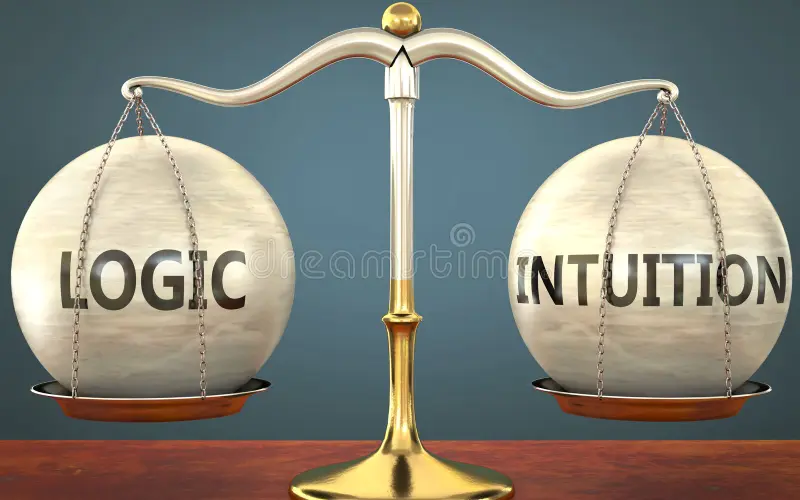
The tension between gut instinct and rational analysis represents not a competition but a complementary partnership. Our brains evolved both systems because each solves different adaptive challenges. Intuition delivers speed, holistic pattern recognition, and embodied wisdom. Rationality provides structure, bias correction, and systematic evaluation.
Modern decision-makers face unprecedented complexity requiring both ancestral intuitive wisdom and contemporary analytical tools. Success doesn’t come from choosing one system over the other but from developing fluency with both and knowing when each serves best. The most profound decisions often arise when gut wisdom and rational insight align, creating the confidence that comes from whole-brain integration.
By honoring intuition’s intelligence while maintaining rational discipline, we access our full decision-making potential. This integration transforms choices from sources of stress into opportunities for growth, gradually building the judgment that characterizes wisdom. The goal isn’t perfect decisions—those rarely exist—but rather developing the discernment to navigate life’s complexity with both head and heart engaged.
